دستور نيوز
Sawsan Muhanna
Saturday 14 March 2026 – 15:48
Source: independent Arabic
The region has entered a stage of real danger, as the warring parties are striking as hard as they can. US President Donald Trump describes Iran as an “evil empire,” and said in a post on the “Truth Social” platform that what matters to him is preventing Iran from possessing nuclear weapons and destroying the Middle East and perhaps the world, and that “the United States is the largest oil producer in the world by a large margin, so when oil prices rise we make a lot of money,” adding, “But what matters most to me, and has importance to me as president, is preventing… The evil empire, Iran, from possessing nuclear weapons and destroying the Middle East and even the entire world,” and “I will never allow that to happen. Thank you for your interest in this matter.”
Trump had considered that Iran was on the verge of defeat in the war, but he warned that American forces were capable of escalating their strikes so that it would become almost impossible to rebuild them. He continued, “We can strike areas in Tehran and other places, and if we do that, it will be almost impossible for them to rebuild their country, and this is what we do not want.” He also said, “We have destroyed all of Iran’s military power and we have complete control over its airspace,” to which the Secretary of the Iranian Supreme National Security Council, Ali Larijani, responded, saying, “It is easy to start wars and end them.” “It will not be through tweets. We will not leave you until you pay the price.”
In turn, the commander of the Iranian Revolutionary Guard Navy, Ali Reza Tangsiri, announced that the Strait of Hormuz would be closed, in implementation of the order of Supreme Leader Mojtaba Khamenei, vowing to direct “the harshest blows to the aggressor enemy,” while Israeli Prime Minister Benjamin Netanyahu indicated, in his first press conference since the start of the war with Iran, that “we are in historic days and the operation against Iran is continuing, and Hezbollah will pay a heavy price because of its aggression against Israel,” and Netanyahu revealed. He said that “we have achieved great achievements that will change the balance in the Middle East. We are changing the Middle East and turning into a regional power and in some areas a global power.”
“The eaten storm” and “The two sa’a’in”
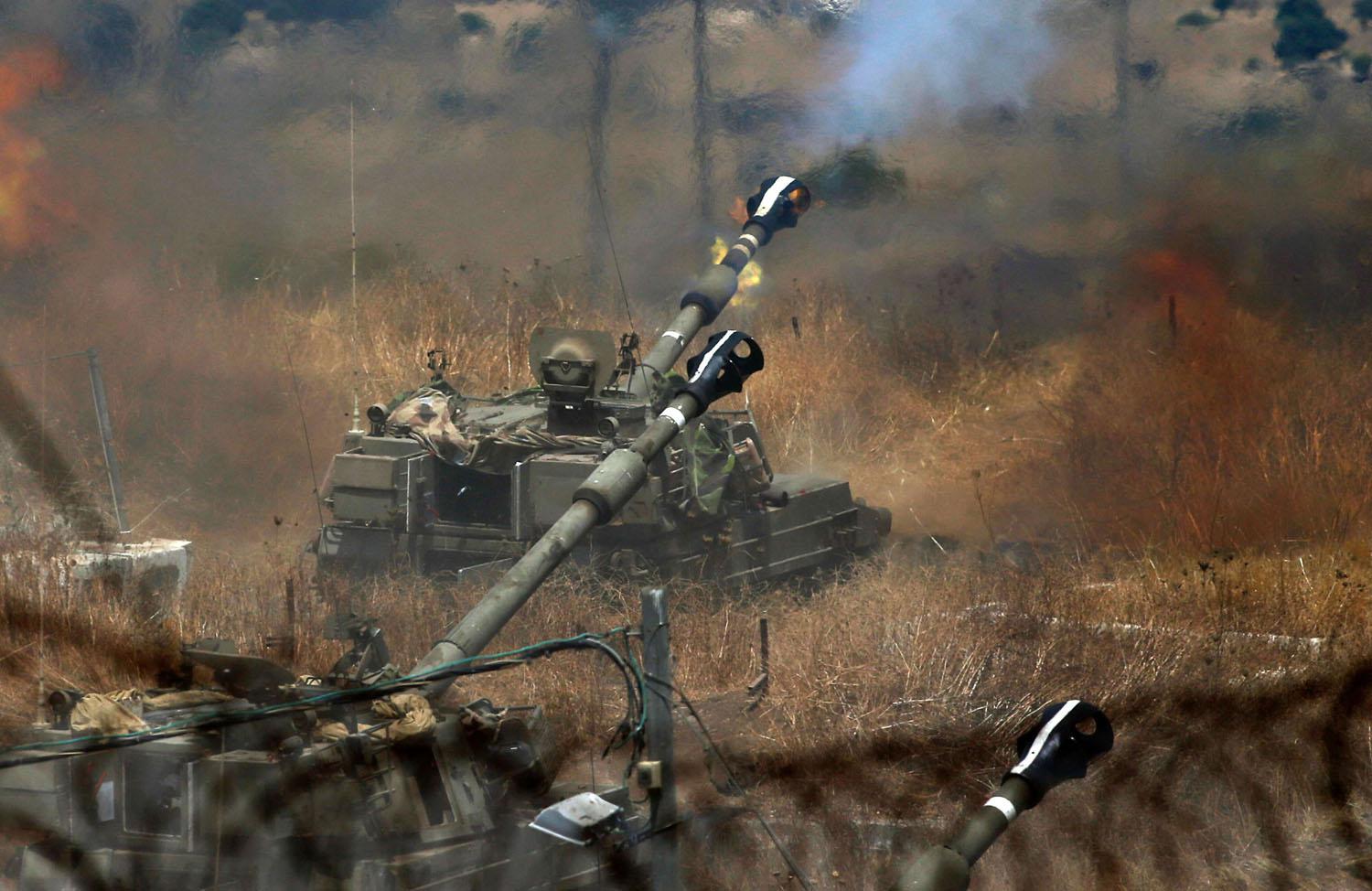
Accordingly, the Israeli raids covered the entire Lebanese territory, from the south to the southern suburb of the capital to the Bekaa and the east and heart of the capital, Beirut, announcing a new phase of strikes, according to Israeli Defense Minister Yisrael Katz, who said that the government that did not fulfill its commitment to disarm Hezbollah will pay increasing prices. He added that the Lebanese government will lose some of its territory until the basic commitment to disarm Hezbollah is implemented, stressing that Israel will increase targeting of infrastructure there, and stressing that the Israeli attacks in Lebanon are “just the beginning.”
In turn, “Hezbollah” announced entry into the open war and called it “the consuming storm.” The response came from Israeli army spokesman Avichai Adraee on the “X” platform, who wrote, “‘Hezbollah’ launched the ‘consuming storm’ and we will return the blow to them in two. If ‘Hezbollah’ feeds on the illusions of (the consuming attack), let it know that the reality of the field proves that the IDF’s strikes are a blow that bounces back on them in two folds, and the field will prove that the attack is two-two times.” And what is coming is greater.”
Open confrontation
Therefore, the region is witnessing an unprecedented escalation in the open confrontation between the United States and Israel on the one hand, and Iran and its network of regional arms on the other hand, in the development of transferring the conflict from the level of shadow war and indirect operations to a more clear and dangerous stage entitled direct strikes, qualitative assassinations, and multiple fronts. The confrontation that was previously managed through limited strikes or secret operations gradually turned into a regional war of attrition in which the Lebanese, Iraqi, Syrian, and Iranian arenas overlap at the same time, with the escalation of the pace of operations. Military and fiery messages exchanged.
In this context, the last phase witnessed a remarkable escalation in deadly strikes and precise assassinations targeting field leaders and figures linked to the Iranian axis, whether within Iran itself or in the spheres of regional influence. Lebanon is no longer immune to this transformation, as Israeli strikes moved from the scope of limited operations to specific targets inside Lebanon, including the capital, Beirut, and areas that are not considered part of Hezbollah’s security environment. This was accompanied by assassinations targeting leaders linked to the Revolutionary Guards, the Quds Force, or the party’s logistical support networks, which reflects the transition of the confrontation to a new level that relies on striking regional command and coordination centers instead of just targeting traditional military structures. The Revolutionary Guard had announced that it was carrying out a joint operation with Hezbollah, which included five hours of continuous shooting, targeting more than 50 targets across Israel. The Guard explained, in a statement, that it fired a mixture of ballistic missiles, while Hezbollah launched what it described as “attack drones and missiles.”
In parallel, American and Israeli strikes continue on sites linked to Iran in more than one arena, while Tehran and its allies respond by opening multiple pressure fronts, launching missiles, or carrying out indirect military operations. This overlap between the fronts has made it difficult to separate what is happening in Lebanon, Iraq, or inside Iran itself, as all of these arenas have become part of a single theater of confrontation that is gradually forming between two regional and international axes. Accordingly, the confrontation today appears to be in a highly sensitive escalating phase, as specific strikes are increasing and the scope of targeting is expanding, at a time when none of the parties has yet succeeded in imposing a stable deterrence equation. While Israel and the United States seek to weaken the military structure of the Iranian axis and strike its regional leadership networks, Tehran and its allies are trying to maintain their ability to respond and open more than one pressure front, making the region stand on the brink of a new phase that redraws the balance of power in the Middle East.
The “new” Supreme Leader Mojtaba Khamenei spoke about “opening new fronts”
His speech, in his first statement, in which he explicitly thanked what he called “the resistance forces in the region,” carried connotations that go beyond a mere moral message to the allies, as it reflects a qualitative shift in Iranian discourse toward the network of regional arms. Tehran, for decades, adopted a policy of ambiguity or “acceptable deniability” regarding the degree of its control over these forces, as they often presented them as independent local movements whose interests intersected with Iran, rather than tools operating within a direct Iranian leadership system. In his statement, Khamenei offered “sincere thanks to the fighters of the Resistance Front. We consider the countries of the Resistance Front to be our best friends, and the issue of the Resistance and the Resistance Front is an integral part of the values of the Islamic Revolution. There is no doubt that the cooperation of the components of this Front with each other shortens the path to salvation from Zionist strife. We also saw that the brave and faithful Yemen did not stop defending the oppressed people of Gaza, and that the sacrificial ‘Hezbollah’ came to help the Islamic Republic despite all the obstacles, and so did the resistance of Iraq.” “Courageously on this path.”
Hence, the public reference and direct thanks to these arms in the context of the current war practically means a political acknowledgment that these forces are part of the conflict equation that Iran is managing at the regional level. This shift in language reflects a change in the nature of the stage. With the confrontation moving to a more direct level between Iran on the one hand and the United States and Israel on the other hand, Tehran is no longer equally keen on maintaining a rhetorical distance between itself and its military allies. On the contrary, it seems to be seeking to demonstrate the cohesion of a regional axis fighting within a single strategic vision, with the aim of sending a deterrence message that any confrontation with Iran will not remain confined within its borders, but will automatically open several fronts in the region. Therefore, thanking these arms is not just a political greeting, but rather an indirect declaration of the unity of the operational front between Tehran and these forces. Likewise, this speech carries an internal and external dimension at the same time.
Internally, it aims to strengthen Iran’s image as the leader of a broad regional axis that extends across several countries, giving the Iranian regime an element of “revolutionary legitimacy” at a moment of major conflict. Externally, it serves as a signal of implicit recognition of the hierarchical structure of the Iranian axis of influence, as Tehran occupies the position of political and strategic leadership, while allied organizations play the role of field arms. This message, even if it is mainly directed to opponents, at the same time carries political consequences for the countries in which these forces are active, because it reinforces the narrative that says that these organizations do not only operate within local calculations, but rather within a broader regional framework led by Iran.
Iranian arms are part of the balance of power in the region
Accordingly, the importance of Mojtaba Khamenei’s speech lies not only in its symbolic content, but also in the transformation it reflects in the level of publicity and clarity. If Tehran in the past relied on a network of agents while maintaining a space of political denial, the current discourse suggests that this stage has ended, and that Iran is presenting the axis of its allies as a unified front in confronting its regional and international opponents. This in itself reflects the scale of the escalation in the ongoing conflict today, as the boundaries between the sponsoring state and the agents are no longer as clear as they were in the past. Previous.
Since the victory of the revolution in 1979, the Iranian leadership has realized that the survival of the regime cannot depend on Iran’s geographical borders alone, but rather requires a security depth beyond the borders. From here was born the idea of building a network of allies and armed organizations in the region, which would later be known as the “Axis of Resistance” or “Resistance.” This network was not only an ideological project, but was, above all, an advanced defense strategy aimed at moving the front lines away from within Iran, and creating indirect tools of deterrence against Tehran’s opponents, led by the United States and Israel. Thus, these arms gradually turned into an essential part of the Iranian national security system, used for military and political pressure when the regime itself is threatened, and this is what is currently happening.
Over the course of four decades, Tehran worked to carefully build this network through financing, arming, and ideological and military training supervised by the Revolutionary Guard, especially the Quds Force. Hezbollah emerged in Lebanon as the first model of a strategic agent capable of combining military and political action. The network later expanded to include armed factions in Iraq, Syria, Yemen, and other places. With the passage of time, these organizations were no longer merely allies of Iran, but rather turned into a regional extension of its military capabilities, giving them the ability to influence in several arenas at the same time, and also giving them the ability to engage in proxy conflicts without directly engaging in a comprehensive war.
However, the current war between the United States and Israel on the one hand and Iran on the other hand has revealed a remarkable paradox. The tools that Tehran created to protect the regime have become a direct part of the battlefield itself. Instead of these arms remaining distant lines of defense, they entered into the confrontation alongside Iran by launching missiles and military operations or by opening multiple pressure fronts in the region. This simultaneous arrangement transformed the conflict from a confrontation limited to Iran to a multi-front regional war, as the arenas of Lebanon, Iraq, Syria, and others became field extensions of the ongoing conflict between Tehran and its opponents.
In this sense, the current war reveals the nature of the equation that Iran has built over the past decades: a regime that seeks to protect itself through a network of regional agents, but the moment it is exposed to direct pressure, it finds that this same network is automatically drawn into the battle, and thus the arms are no longer merely tools of deterrence, but rather have become part of the balance of power in the larger conflict ongoing over the future of Iranian influence in the Middle East.
If we consider that the Iranian regime may fall, who will fall first, it or its proxies?
Most likely, and with cold logic and not political desire, Iran’s arms will begin to fall or disintegrate before the fall of the Iranian regime itself, but the word “fall” here does not mean the same thing in both cases. The arms may fall militarily and functionally first, while the regime’s fall may be delayed because it has a state center, repressive apparatuses, and sovereign resources that make it better able to absorb strikes from its agents. On the other hand, if the center in Tehran is shaken to the point of losing the ability to finance, lead, and deter, the fall of the arms may turn from gradual erosion to rapid and serial collapse. This makes the most accurate answer: the arms are exhausted first, but their ultimate fate remains linked to the survival of the regime itself.
The first reason is that the agent, no matter how large, remains structurally weaker than the sponsoring state, but the Iranian regime still has what the arms do not have, in terms of central security institutions, the Revolutionary Guard, intelligence services, national borders, energy resources, and a state bureaucracy capable of redistributing losses. As for the arms, they depend on three very sensitive things: the financial flow from Tehran, the logistical corridors, and the cover of local legitimacy, and when these elements strike, this is what the strikes work on. American and Israeli, the agent becomes exposed even if he remains capable of harm, and that is why we see today that the financial pressures on Iranian oil and finance networks explicitly target Tehran’s ability to support the agents, not just Iran’s internal ability.
“Hezbollah” is the first candidate to fall
If we take “Hezbollah” specifically, it appears to be the first candidate among the arms to be the quickest to lose its former regional function, not only because of military attrition, but because the environment in which it was moving has changed. There is mounting official Lebanese pressure to limit and ban weapons, and a UN briefing was received this week about Lebanon being “exhausted by the wars of others,” and current estimates speak of a weak party, but it has not yet been completely defeated. What is more dangerous for him is that his cost to the Lebanese interior has become higher than before, while his margin of maneuver is narrower, meaning that the party may not disappear quickly, but it is gradually losing its character as a flexible offensive arm, and becoming a defensive burden besieged inside Lebanon.
This is a kind of functional downfall even before a complete organizational downfall.
Published articles represent the opinion of their authors
#burns #regional #war #Iran #agents #Voice #Lebanon #Voice #Lebanon
Who burns first in the regional war, Iran or its agents? – Voice of Lebanon – Voice of Lebanon
– الدستور نيوز
اراء و اقلام الدستور – Who burns first in the regional war, Iran or its agents? – Voice of Lebanon – Voice of Lebanon
المصدر : www.vdl.me