
دستور نيوز
Kamel Jaber
Wednesday, May 6, 2026 – 17:15
Source: Independent Arabia
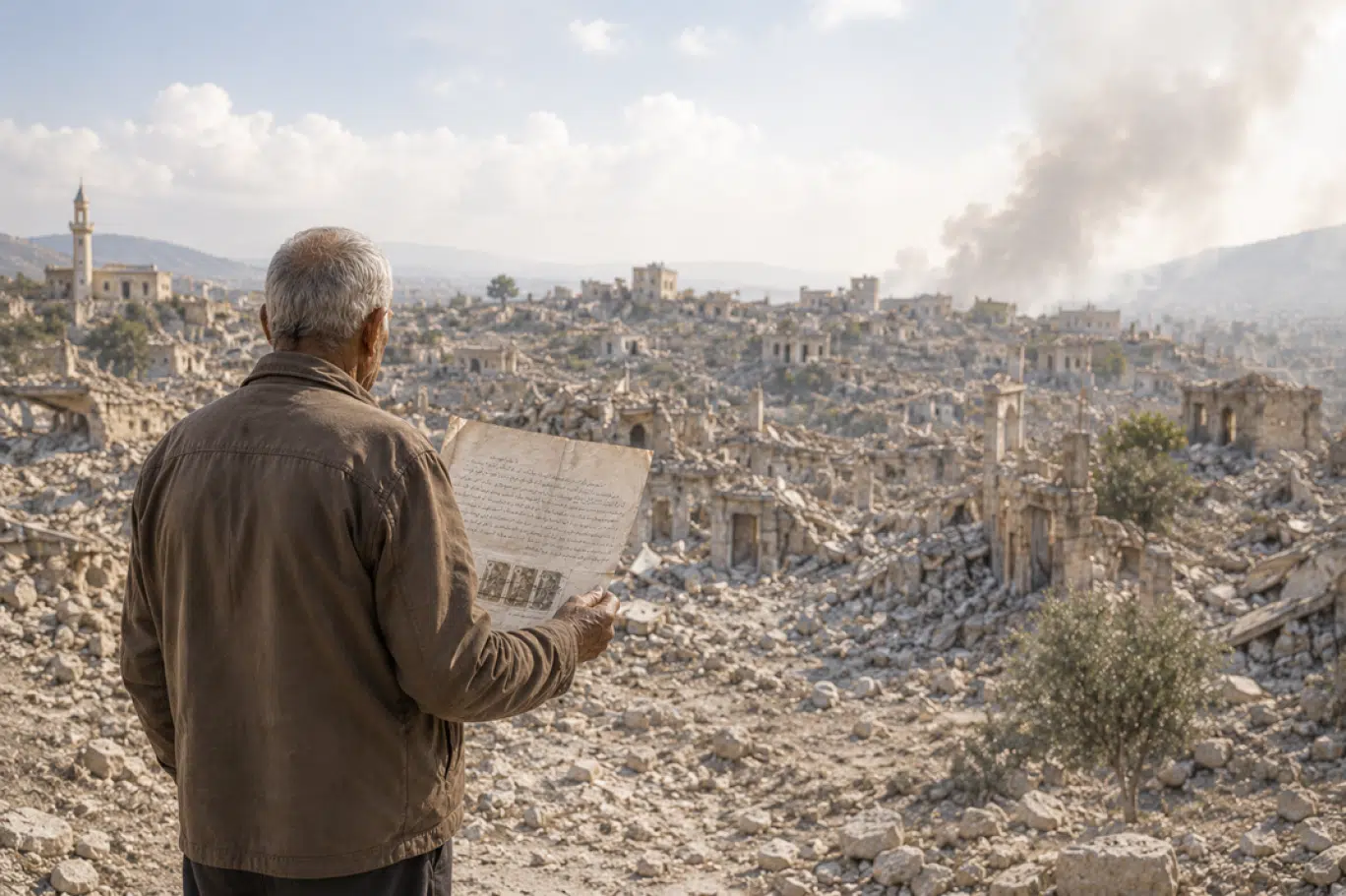
The ongoing Israeli wars on Lebanon, specifically its south, for decades, the most recent of which was the 2024 war and the current war that began on the second of last March, and were distinguished by the extent of the almost total destruction carried out by Israel in entire villages and cities, not only destroyed lives, buildings, agricultural, forestry, environmental, heritage and archaeological wealth, but also destroyed what the homeowners owned or stored in terms of identification papers, ownership documents, and purchase and sale deeds. Receipts, invoices, and souvenir photos, thus creating future problems for them, especially after Israel bombed homes and infrastructure, or blew them up after booby-trapping them, or blew them up and then bulldozed them to change the features of the towns, which today are no longer clear, thus losing real estate boundaries and mixing private properties with the public.
We learned that the General Directorate of Real Estate Affairs in Nabatieh Governorate, to which the districts of Marjayoun, Bint Jbeil, and Nabatieh belong (and Hasbaya outside the war), were unable to evacuate and remove the documents belonging to it in the real estate departments or offices, especially in the city of Bint Jbeil, the capital of the district, as the total destruction affected all the buildings belonging to official and governmental institutions, which will inevitably create problems and confusion in the future in the villages and cities that were completely demolished, or some of their neighborhoods were completely destroyed. Completely, especially for owners of building or real estate properties who have lost the papers, documents and proof that confirm their ownership of real estate.
Real estate problem in Bint Jbeil
Although the surveyed real estate data is preserved and automated at the General Directorate of Real Estate Affairs in the capital, Beirut (affiliated with the Lebanese Ministry of Finance), the loss of complete papers, bonds, and contracts for a large number of owners, or the similarity of names, especially in border villages, will lead, at the very least, to confusion in determining ownership on the land, which later requires securing additional documents that help confirm rights so as not to create disputes between property owners that require resorting to the judiciary to legally establish ownership, and the matter may require many years of lawsuits and reconciliations.
According to circulated information, without official confirmation, Israeli forces burned the files of real estate departments in the city of Bint Jbeil. Administrative and security reports stated that the concerned authorities in the Land Registry Secretariat and the city’s surveying departments were unable to produce modern documents and maps due to the accelerating field and military conditions. Media reports indicated that the real estate situation in Bint Jbeil has become very difficult, as there are fears that the Lebanese state does not maintain backup copies of all real estate documents and maps, which makes lost or burned paper files at risk of permanent loss.
Jaber: We do not know the extent of the problem
In an exclusive interview with “Independent Arabia”, Finance Minister Yassin Jaber reveals that “information about the loss of real estate records and maps in Bint Jbeil is not confirmed yet, as no one has been able to reach there. About a month and a half ago, we tried to enter the city’s palaces to extract documents, but we were unable. We spoke to the Lebanese Army Intelligence, the ‘Mechanics’ Committee, and the ‘UNIFIL’ forces. The last attempts were with the International Red Cross, about 10 days ago, and through the Director General.” Civil Defense (assigned) Brigadier General Imad Khuraish, who is from Ain Ibel Jarah Bint Jbeil, and until this moment we have not been able to reach her.”
Minister Jaber added, “Last week, we were able to remove the files and documents from the Marjayoun Brigades, and we are currently seeking to remove the documents from the city of Nabatieh. We were delayed because we were considering that Nabatieh is currently outside the military zone, but I gave my orders to remove them out of caution. On the other hand, if we enter the Ministry of Finance system, we can obtain a real estate affidavit from anywhere in Lebanon, stating the owner of the property and its circumstances, but what we could lose, for example, are scanned sales contracts. The ministry did not have an electronic system that could preserve With a copy of it, but we still know who the property belongs to, and if anything happens, God forbid, we will remove the Nabatieh files immediately, and there are no real estate records in the city of Tire because its districts are in Sidon, and we have begun to open an independent real estate office there, but we were late in implementing it and it seems that our delay was due to our luck.”
The South is paying a big price
Minister Jaber pointed out that “many villages and towns in the Bekaa, for example, do not have a survey area, and there are other places where the surveying operations have not been completed, but in the large cities and towns the real estate has been completely surveyed.” He confirms, “Everything is almost registered, and there are papers here or there that help identify properties, even if they were registered long ago. But in the event of the bulldozing and comprehensive destruction carried out by Israel, we will have to re-conduct a complete survey again, and so far we cannot estimate how bad the situation is, because no one was able to enter the destroyed villages to inspect the extent of the damage. There are satellite images and we hear from the news circulating, and the Scientific Research Institute photographs what it can, including satellite images, and coordinates with the World Bank to prepare a report on the losses, and everything else.” “We currently have it in our hands through what these satellites transmit.”
The Minister of Finance confirms that “there is a tragedy in what is happening in the south in every sense of the word, and the issue in the south is no longer local or regional, and if the countries whose goal was stability in the region are currently unstable, what about Lebanon? We are waiting for how things will end, but southern Lebanon is paying a heavy price, and the disaster that we are trying to avoid or prepare for is the morning of the next day, the day the residents return to where there is no housing or homes, so we are trying to get whatever money we can or some loans, but no one is currently helping us without Emotion and sympathy, but not money. Therefore, we are trying, through some loans, at least, to prepare for the next day of the ceasefire, and to be present to pay rent, for example, and aid as much as possible, and we will not forget that the Lebanese state’s condition is also at rock bottom.”
Documents under the rubble
Muhammad Rammal, a resident of the southern town of Adissa (Marjayoun District), confirms that “our town has been surveyed since 2010, but the land where Israeli settlers recently appeared and are talking about establishing a colony belongs to us in Adissa, and goes back to my grandfather, the late former Mukhtar Salman Rammal. There is space and there are objections and complaints pending in the courts. But after the total destruction and bulldozing operations carried out by the Israeli army in our town and other border villages, there is an urgent need to redefine and survey, and satellites can be used.” There are many residents in the last two wars, 2024 and 2026, who lost most of their identification documents, especially real estate ones, as they left their homes with whatever clothing they could to protect them from the heat or the cold, and did not return to them after the Israelis destroyed and bulldozed their homes, so documents and personal identification papers were lost under their rubble.
Rammal, an activist in the Southern Border Villages Association, points out that “there are lands from the Adissa estates that have remained under Israeli control to this day since 1967. They were annexed to the neighboring ‘Miskav Am’ colony and were later determined by the demarcation of the Blue Line after the year 2000. The Israelis did not withdraw from them, and an unresolved controversial point remained between Lebanon and Israel, 200 meters deep and 5.1 kilometers long, and it was determined for us by real estate judge Ahmed Mezher.” Based on the satellite image, my grandfather has a land of about 40 dunums that he cultivated before 1967. Israel occupied it and then cut off about 25 dunums from it.
Rammal talks about “a real estate problem in Adaissa caused by a number of people from our town buying properties that they bought from another family and building houses and buildings on them of several floors. It later became clear that these properties belong to the Lebanese treasury. This means that if they return to their village and find that their homes have been destroyed, the state will not allow them to rebuild what was demolished on the grounds that what they built previously is considered a violation. This means that they will have no homes if the Lebanese state concludes a reconciliation with them, since they owned The houses do not own the land on which they were built.”
The rest of the papers and memory
Lawyer Jihan Diab says, “The process of identifying and liberating unsurveyed lands in southern Lebanon (and other Lebanese regions) is a legal and technical procedure aimed at fixing the boundaries of real estate, separating it from the commons, and identifying the rights holders in it to document it in the real estate registry. This process takes place through precise stages in accordance with Resolution No. 186 of 1926, and requires the presence of surveyors and real estate judges to the areas in question.
In the case of the loss of real estate documents for the unsurveyed boundaries in villages and towns destroyed by Israel, their owners must submit a request to the relevant municipalities to carry out identification and planning with the papers they have left, or obtain possible papers in the cadastral departments in the cities and the capital, Beirut, or aerial photography documents, then bring witnesses from neighbors or rely on memory.
Lawyer Diab confirms that “most of the border villages whose area was destroyed and bulldozed are located in the real estate departments in the governorates and in Beirut, after which all residents of the town or village must be present to prove their real estate and property, and the state is left with the matter of determining, planning and dividing. I do not underestimate the problem, but rather confirm that there is an actual problem coming even if the area exists, as there are precise details that will remain up for debate, and the process of proving rights will not take place in a day or two, but rather it will take many years, and may remain open. In the western Bekaa (east) In a previous war, documents were destroyed, so those concerned repeated what is called the process of ‘building the file’, and then all the remaining papers, evidence, certificates and witnesses are prepared to be presented to the real estate judge so that he can take a decision determining the property and its owners.
Complaint against Israel
We ask, “If the geographical features of a village change, as happened with a huge bombing in the village of Qantara (Marjayoun) that toppled hills, filled in depressions, and changed the geographical terrain, what will the rights holders do?” Lawyer Diab answers, “Then the Lebanese state must be resorted to for compensation in kind. The Lebanese state must file a complaint against Israel for destroying and bulldozing homes, and then summon the property owners to listen to them, make reconciliations, and provide compensation if necessary.” That, or conducting a comprehensive survey and a new division through which all parties are satisfied, and this depends on people’s awareness and understanding of what happened, and if something is lost, it must be compensated with materials or in another alternative location.”
As for the violating buildings, Lawyer Diab explains, “Whoever built a house in violation of the laws in the past, especially in the border area that was subject to Israeli occupation between 1978 and 2000, that is, for 22 years, must turn to the state in search of some redress or compensation. If the violation is in real estate belonging to the Lebanese state, then there are many cases that have been dealt with previously, or if it is on private property, some reconciliation must be made, knowing that Owners of registered properties have the right to regain their rights if the violating building is demolished, and there is what is called possession. If a property is seized for more than 15 years without any objection or any complaint, it becomes private property, and as a result, we are facing a major tragedy in terms of reconstruction or identification of property and real estate.
Legal and technical reading
In a legal and technical analysis of dealing with the crisis of documents that were destroyed by the war, the head of the Syndicate of Real Estate Appraisers in Lebanon, Khader Yamout, said, “Lebanese law protects private property as a constitutional right that does not lapse with the disappearance of physical landmarks. And in the surveyed areas (determination and final editing), the situation is legally sounder because the real estate boundaries and areas are fixed in the real estate records of the real estate departments and in the official cadastral maps.”
He continued, “Total demolition does not legally eliminate the existence of the property. However, in unsurveyed areas, ownership here depends on ‘management’ and natural landmarks (stone chains, old trees, side roads). With the disappearance of these landmarks, proving the geographical extent of the property becomes complicated and requires exceptional measures.”
He added about determining the areas after the complete demolition, “Upon return, the rights holders will not rely on the surveyed land features, but rather on the digital cadastral upload, as the maps of the Directorate of Geographic Affairs in the Lebanese Army and the maps of the Survey Department are used. The previously recorded coordinates (Coordinates) are projected onto the ground using high-precision GPS devices, which allow determining the corners of the property even if the land is a “single rug” and with an accuracy of up to a few centimeters.”
The captain explains, “In the event of loss of proofs and old title deeds and in the absence of an official survey, the following means are resorted to to confirm rights: Real estate judiciary, that is, resorting to the judge of urgent matters or the real estate judge to prove the fact of ownership. Alternative real estate statements, which means reviewing the cadastral departments to obtain copies of the ‘cadastral maps’ or ‘determination records’ if the area has witnessed incomplete demarcation and editing processes. The certificate of neighborhood and fame, as Lebanese law adopts the “neighbourhood certificate” as legal evidence in unsurveyed areas. Where the owners of the properties surrounding the property’s borders testify.”
National emergency survey committee
He continues, “One can resort to records of family ties and local survey books (optional surveying) kept by mukhtars or municipalities, which often include details about the payment of fees or previous building permits. In addition to the role of satellite images and historical photos, high-resolution images are available taken before the destruction, clearly showing the boundaries of walls, stone chains, and the distribution of buildings. And technical conformity, so surveying engineers carry out the process of “projecting” these old images onto the current scanned reality. This allows the boundaries to be redrawn with extreme accuracy. And criminal documentation, so that these photos can be used as evidence before Lebanese courts and even international forums to prove the extent of the damage and determine the exact locations of private property before it is bulldozed.”
Through his union status, Yamout advises “all those affected to conduct immediate documentation, including collecting any old photos of homes (even family ones) that show surrounding landmarks. And to review the civil organization and municipalities to obtain copies of old building permits, as they contain accurate cadastral maps of the site. And to demand the formation of a ‘National Emergency Survey Committee’ that includes the Syndicate of Engineers, the Lebanese Army, and the General Directorate of Real Estate Affairs, to unify the technical reference and prevent disputes between neighbors during reconstruction.”
He concluded, “The absence of landmarks on the ground does not mean the loss of the right. Today, science and law possess sufficient tools to redraw every inch as it was.”
Published articles represent the opinion of their authors
#homes #real #estate #documents #war #erases #property #southern #Lebanon #Voice #Lebanon #Voice #Lebanon
No homes and no real estate documents: a war that erases property in southern Lebanon – Voice of Lebanon – Voice of Lebanon
– الدستور نيوز
اراء و اقلام الدستور – No homes and no real estate documents: a war that erases property in southern Lebanon – Voice of Lebanon – Voice of Lebanon
المصدر : www.vdl.me