
دستور نيوز
Tony Boulos
Tuesday 14 April 2026 – 14:53
Source: independent Arabic
After 43 years, Lebanon is once again entering the path of direct negotiations with Israel, but this time after it was gradually liberated from three successive guardianships that governed its sovereign decision-making for many decades. The first guardianship began in practice after the “Cairo Agreement” in 1969, which legitimized the armed struggle across Lebanese territory and granted the “Palestine Liberation Organization” broad security and military influence within the Lebanese state, before it later turned into a force dominating a large part of the national decision-making process and over large areas of Lebanese geography. As for the second guardianship, it came with the Syrian intervention, which began under the title of “Arab Deterrence Forces” and then took hold after the “Taif Agreement,” when the Arab armies withdrew and the Syrian regime’s army remained alone in control of the political and security joints of the Lebanese state. After the withdrawal of Syrian forces in 2005, the third guardianship began, which is Iranian hegemony through Hezbollah, which reproduced the equation of control over the decision of war and peace from outside state institutions.
For the first time in nearly half a century, Lebanon is entering the negotiation process with Israel under fire. The southern front is still burning, and the military clash between Hezbollah and Israel has not stopped. However, a direct political channel is being opened in Washington to discuss the future of the relationship between the two countries.
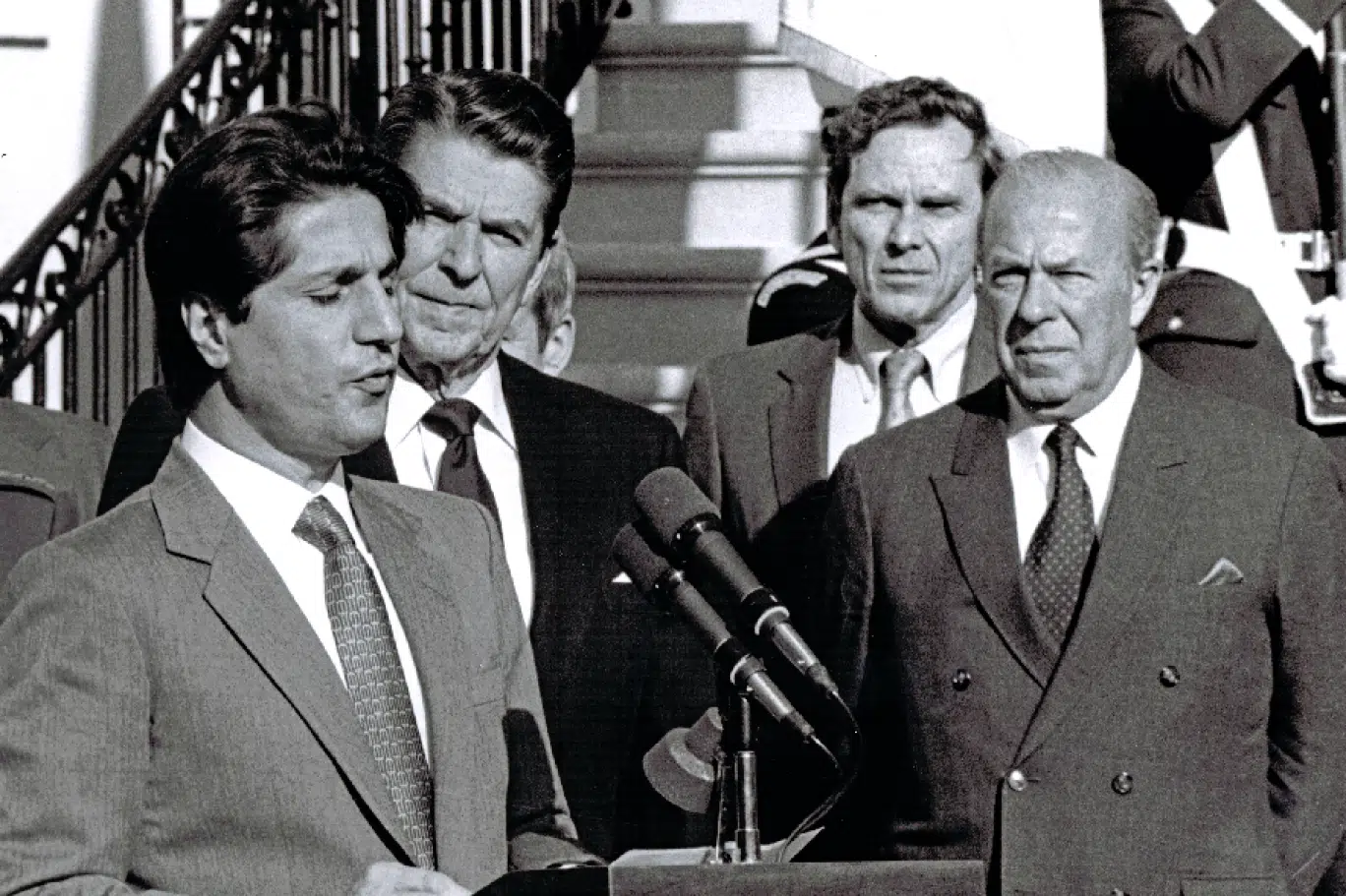
This paradox is not new in Lebanese history, but rather it is almost a reformulated version of a pivotal moment that Lebanon experienced in 1983 when it also entered a negotiating track with Israel after the 1982 invasion, and signed the May 17 agreement, before this agreement fell after less than a year under internal and regional pressure led by Syria with the support of its allies inside Lebanon on February 6, 1984.
Use allies
The negotiation expected today does not begin in a vacuum, but rather from the intersection of statements exchanged between Beirut and Tel Aviv that suggest the presence of a political will to push the path forward despite the continuation of military operations. Israeli Prime Minister Benjamin Netanyahu clearly announced that his country is ready to negotiate with Lebanon according to two basic conditions: disarming Hezbollah and reaching a formal peace agreement, while the Lebanese side declares that its first goal is a ceasefire, in preparation for the transition to broader arrangements. This difference in defining the goal of negotiation reflects a fundamental difference in the position of each party in the political process: Israel wants to reformulate the strategic equation in Lebanon, while the Lebanese state is trying to extract a truce that opens the door to re-establishing its sovereignty over the decision of war and peace. However, what is striking in the current context is that the Lebanese government itself, during a government session a few weeks ago, announced that Hezbollah’s military action had become outside the state’s legal legitimacy. This is a qualitative transformation that was not available during the “May 17” agreement, when the state itself was unable to confront the military structure of the “Palestine Liberation Organization” and the national movement that arose outside of it. Noting that in 1983, Lebanon was negotiating with Israel in light of the direct Israeli occupation of large parts of its territory, including the capital, Beirut, and in light of a heavy Syrian military presence as well, meaning that the Lebanese state was practically moving between two competing occupiers on its land. However, it was able at that time to go on to sign a relatively comprehensive agreement that stipulated ending the state of war, organizing the Israeli withdrawal, establishing security arrangements in the south, and establishing joint liaison committees in preparation for organizing relations between the two countries.
Observers of that stage believe that the problem was not in the text of the agreement nor in its legal nature, but rather in the regional environment that surrounded it, as Syria considered the agreement to be an attempt to remove Lebanon from the orbit of its strategic influence, so it rejected it completely, and used its Lebanese allies to bring it down through what was known as the “uprising” of February 6, 1984, which practically constituted a political and security coup that ended the Lebanese state’s ability to implement its obligations and forced it to officially withdraw from the agreement.
History repeats?
Today, this political memory is strongly returning to the forefront, because major Lebanese parties have re-raised almost the same objection, but in a different language. Parliament Speaker Nabih Berri previously announced his refusal to send a Shiite delegate to the negotiations, and Druze leader Walid Jumblatt linked any negotiating track to the Arab Peace Initiative, while the President of the Republic, Joseph Aoun, is trying to separate the Lebanese track from all previous regional references and proceed from the interest of the Lebanese state alone. The biggest transformation that distinguishes the current moment from the 1980s is the fall of the direct Syrian role in Lebanon. In 1983, Damascus was exercising effective guardianship over the Lebanese decision-making process and possessing military forces deployed on Lebanese territory. It was able to impose its choices by political and military force, but today the Syrian regime itself has moved out of the position of the central player in the Lebanese equation. This shift does not mean the end of regional influence in Lebanon, but it does mean the shift of the center of gravity from Damascus to Tehran, that is, from direct tutelage to indirect influence exercised through Hezbollah.
Arabic context
In this context, the atmosphere at Baabda Palace indicates that engaging in peace negotiations with Israel does not mean a departure from the Arab context, pointing to the change in the Arab framework, which in the past constituted a mandatory reference for the Lebanese position on the conflict with Israel. In the past decades, Egypt signed the “Camp David Accords,” Jordan signed the “Wadi Araba Agreement,” and Syria itself remained in a state of long truce with Israel, while today the region is witnessing additional transformations that include new security and political understandings between Israel and a number of Arab countries, in addition to open discussions with Damascus about future security arrangements. This transformation means that the idea of an Arab consensus rejecting any single Lebanese agreement with Israel no longer exists as it did in the 1980s, and that Lebanon is no longer practically obligated to remain within a single regional framework in determining its strategic options.
At the moment when the first round of negotiations begins in Washington between the Lebanese Ambassador to the United States, Nada Hamada Moawad, and the Israeli Ambassador to Washington, Yechiel Laiter, inside the headquarters of the US State Department, fears among some about the new path, from which France has been taken out of context, return to the forefront.
Political circles fear that removing France from the negotiating table will be an obstructing factor in its path rather than a facilitating factor, based on the influence of Paris through its deep relations with some of the main political forces, most notably the Speaker of the House of Representatives and former head of the “Progressive Socialist Party,” Walid Jumblatt, which may push some forces to the opposition position for direct negotiation. These circles link this French output to a broader European approach that called for the inclusion of the Lebanese front within any possible regional understanding between the United States and Iran, given that the Lebanese arena remained during the last stage part of the open regional clash between the two parties. Some Lebanese are interpreting the French position in this context as an attempt to keep the Lebanese file within its broader regional framework, rather than isolating it in a separate bilateral negotiating track sponsored by Washington alone, especially since influential Lebanese parties, led by Nabih Berri, tended to keep the Lebanese track connected to the regional balances linked to the Iranian front, based on the fact that the Lebanese front practically remained part of the broader engagement system during the last stage. According to this reading, France and some of the Lebanese forces intersecting with it would have preferred to continue addressing the Lebanese file within the framework of the five-member committee for Lebanon, and not within a bilateral negotiating path mediated by America.
The state was not the decision maker
Writer and political researcher Makram Rabah considers that recalling the experience of the “May 17” agreement is necessary to understand the nature of the chronic Lebanese impasse linked to the absence of the state’s monopoly on the decision of war and peace, pointing out that “the 1983 agreement was not dropped because of its content or because it was a peace agreement with Israel, but rather because it collided with the reality that the Lebanese state did not have the actual ability to implement what it signed. The problem was not in the text but in the balance of power that governed Lebanon at the time, as Syria considered that any Lebanese settlement with Israel would be independent.” It means removing Lebanon from its vital sphere, so it used its local tools to drop the agreement.” He considered that “the current regional transformations are radically different from the phase of the 1980s, as there is no longer an Arab consensus that prevents any settlement with Israel, and Syria no longer exercises the role of direct guardian of the Lebanese decision, which opens a different window for Lebanon that was not available in 1983.” He warned, on the other hand, that this window will not turn into an actual opportunity if the military structure outside the country remains capable of disrupting any negotiating path. Therefore, in his opinion, the real question today is not whether Lebanon will go to negotiation, but rather whether it will be able to protect the results of the negotiation if it occurs? Because experience has shown that agreements do not fall when they are signed, but rather when the state is unable to impose them.
The opportunity to leave the arena
Journalist and political analyst Raghida Dergham, in turn, believes that the experience of the “May 17 Agreement” is a pivotal moment in Lebanon’s modern history, but “its importance today lies in its ability to explain the nature of the conflict over Lebanon’s regional identity more than in the content of the agreement itself.” In her political approaches, Dergham pointed out that the 1983 agreement “was part of an American attempt to reintroduce Lebanon into the logic of the state after years of turning it into an open arena for regional conflicts, but this attempt collided with Syrian rejection.” It is crucial to prevent the establishment of a Lebanese settlement independent of Damascus’s strategic calculations.” She considered that “a comparison with the current moment reveals the shift of the center of regional obstruction from Syria to Iran, but with a fundamental difference that the Arab and international environment has changed radically since the 1980s. Lebanon today is no longer surrounded by a unified Arab wall that rejects any settlement with Israel, and the region itself is witnessing broad shifts in the nature of the relationship with the Hebrew state, whether through official agreements or undeclared security understandings.” Hence, she saw that the current negotiating path cannot be achieved. It can only be understood within an internal Lebanese context. Rather, it must be read within a broader restructuring of the regional order in the Middle East.
Dergham pointed out, “The experience of ‘May 17’ provides a clear lesson, as it demonstrated that any agreement that does not have internal sovereign cover and actual implementation capacity will remain vulnerable to its failure, regardless of the international support for it. Therefore, the current moment may be a historic opportunity for Lebanon to get out of the arena, but it may also turn into a new reproduction of the logic of guardianship if the authority for the decision is not established within state institutions.”
Change in the Arab environment
For his part, researcher and political writer Sami Nader says that bringing up the “May 17 Agreement” in the current Lebanese debate is an indication that Lebanon is once again facing a pivotal moment related to determining its position in the regional conflict. He pointed out that the agreement in 1983 was an attempt to re-establish the Lebanese state after the Israeli invasion, but it fell because the regional environment did not allow for an independent Lebanese settlement. He stressed that the comparison with the current stage reveals a radical shift in this environment, as the Arab regional order no longer exists. It works according to the same logic that prevailed in the 1980s. A number of Arab countries moved to sign peace agreements with Israel, while other countries chose to adopt indirect security arrangements, which means that Lebanon is no longer governed by the same restrictions that prevented any unilateral settlement in the past. Nader pointed out, at the same time, that changing the regional environment alone is not enough to guarantee the success of any new negotiating path, “because the decisive factor remains internal and relates to the ability of the Lebanese state to restore its strategic decision,” and pointed out that “the experience of 17 May proved that international agreements cannot survive if they are not based on an internal balance that allows them to be implemented, and that any new negotiation today will face the same challenge if the issue of weapons remains outside the framework of the state without a solution. Therefore, the success of the current negotiating path will not only depend on the nature of regional or international pressures, but rather on the ability of Lebanon itself to transform from an arena of conflict to a state that negotiates in the name of its institutions and not in the name of its axes.
Lebanon and the search for a new equation
On the other hand, journalist Khalil Nasrallah, known for his closeness to Hezbollah, presented a radically different approach to the current negotiation path with Israel, as he saw that “restoring the experience of the ‘May 17’ agreement is an attempt to impose a settlement on Lebanon outside of its internal balances and outside the context of the regional conflict with Israel,” considering that this type of agreement cannot be separated from American and Israeli pressures aimed at reshaping Lebanon’s position in the region, and pointed out that “the ‘May 17 agreement’ fell because it did not reflect the real balance of power.” Within Lebanon, he even tried to impose a major political option in light of the presence of direct Israeli occupation and in light of sharp internal division, so it was considered at the time an unviable agreement.” From this standpoint, he saw that the talk today about peace negotiations, or even about security arrangements that go beyond the ceasefire, carries the same dangers if it is not linked to what he called “the deterrence equation imposed by the party” on the southern border during the past decades. Nasrallah went further when he considered that including Hezbollah’s weapons among the terms of the negotiation, as Israel demands, “reveals that the real goal of the current path is not to end the war, but rather to change the balance of power within Lebanon,” and in his opinion, “any negotiation starting from this title will not be a negotiation between two countries, but rather an attempt to reformulate the Lebanese interior itself, which makes the comparison with the 1983 experience more realistic than it appears on the surface.”
He pointed out that the regional transformations that are used today to justify opening the door to negotiations, “such as Arab countries signing peace agreements with Israel, do not mean that Lebanon is obligated to move in the same direction, because its geographical location, political composition, and role in the conflict with Israel differ from those of those countries.” Therefore, “any negotiating path that does not take into account this specificity will remain vulnerable to internal vibration, just as happened with the ‘May 17’ agreement, which fell when it collided with the rejection of it by major Lebanese forces,” and from here he concluded that the real debate today is not about The possibility of negotiation itself, “but rather about whether Lebanon wants to reproduce the experience of an agreement that fell four decades ago, or search for a different formula that balances the logic of the state and the logic of the resistance (Hezbollah) within a new equation.”
Published articles represent the opinion of their authors
#Lebanon #opens #path #peace #Israel.. #experience #agreement #repeated #Voice #Lebanon #Voice #Lebanon
Lebanon opens the path to peace with Israel… Will the experience of the “May 17” agreement be repeated? – Voice of Lebanon – Voice of Lebanon
– الدستور نيوز
اراء و اقلام الدستور – Lebanon opens the path to peace with Israel… Will the experience of the “May 17” agreement be repeated? – Voice of Lebanon – Voice of Lebanon
المصدر : www.vdl.me