
دستور نيوز
Tony Boulos
Thursday, March 26, 2026 – 14:10
Source: independent Arabic
It seems that Lebanon has actually come within range of Iranian missiles. The incident that took place in the skies over the Lebanese coast last Tuesday, with a missile explosion or air interception recorded over the Keserwan region, is no longer read as an isolated military incident, but rather as a political and security indication of Lebanon’s transition from a “support front” position in the regional conflict to a potential location within the theater of direct Iranian response to American interests.
This development comes in conjunction with unprecedented Lebanese steps towards Tehran, most notably considering the Iranian ambassador as persona non grata and asking him to leave the country within a few days, which prompted some political circles to read the latest incident as an indirect message of response within the equation of mutual deterrence between Iran and the United States. At the same time, previous Iranian threats to include Lebanese military sites, such as the Hamat Air Base located in the north of the country and Rayak Military Airport in the Bekaa region in the east, as part of a potential “bank of targets”, raised a major question: “Has Lebanon officially become part of the equation of the American-Iranian engagement?”
Message in the air
To clarify what happened in the Keserwan area two days ago, the Lebanese army issued a statement yesterday, Wednesday, in which it said, “The ballistic missile whose parts fell inside Lebanese territory is likely to have exploded as a result of a technical defect or an interception operation.”
He continued, “The results showed that the Iranian-made Ghadr-110 guided ballistic missile was about 16 meters long and had a range of about 2,000 kilometers. It contained several small-sized missiles and exploded at a high altitude, which makes it likely that its target was outside Lebanese territory.”
The Army Command confirmed that “there are no interceptor missile platforms inside Lebanese territory,” and concluded by noting that investigations are continuing to uncover the circumstances of the incident.
On 3/24/2026, following the fall of parts of a missile over a wide geographical area, specialized units of the army conducted an immediate field survey, collected the parts and analyzed them, and the result was found to be a guided ballistic missile of the “Gadr-110” type, Iranian-made, with a length of about 16 meters and a range of about two thousand kilometers, and containing several missiles.
The Lebanese Army’s explanatory statement suggested that the target of this missile was outside Lebanon, but it did not definitively resolve the matter. On the other hand, dozens of security reports and information came out confirming that the target was American interests in Lebanon, especially since the launch of this missile came only two hours after the decision to expel the Iranian ambassador to Lebanon.
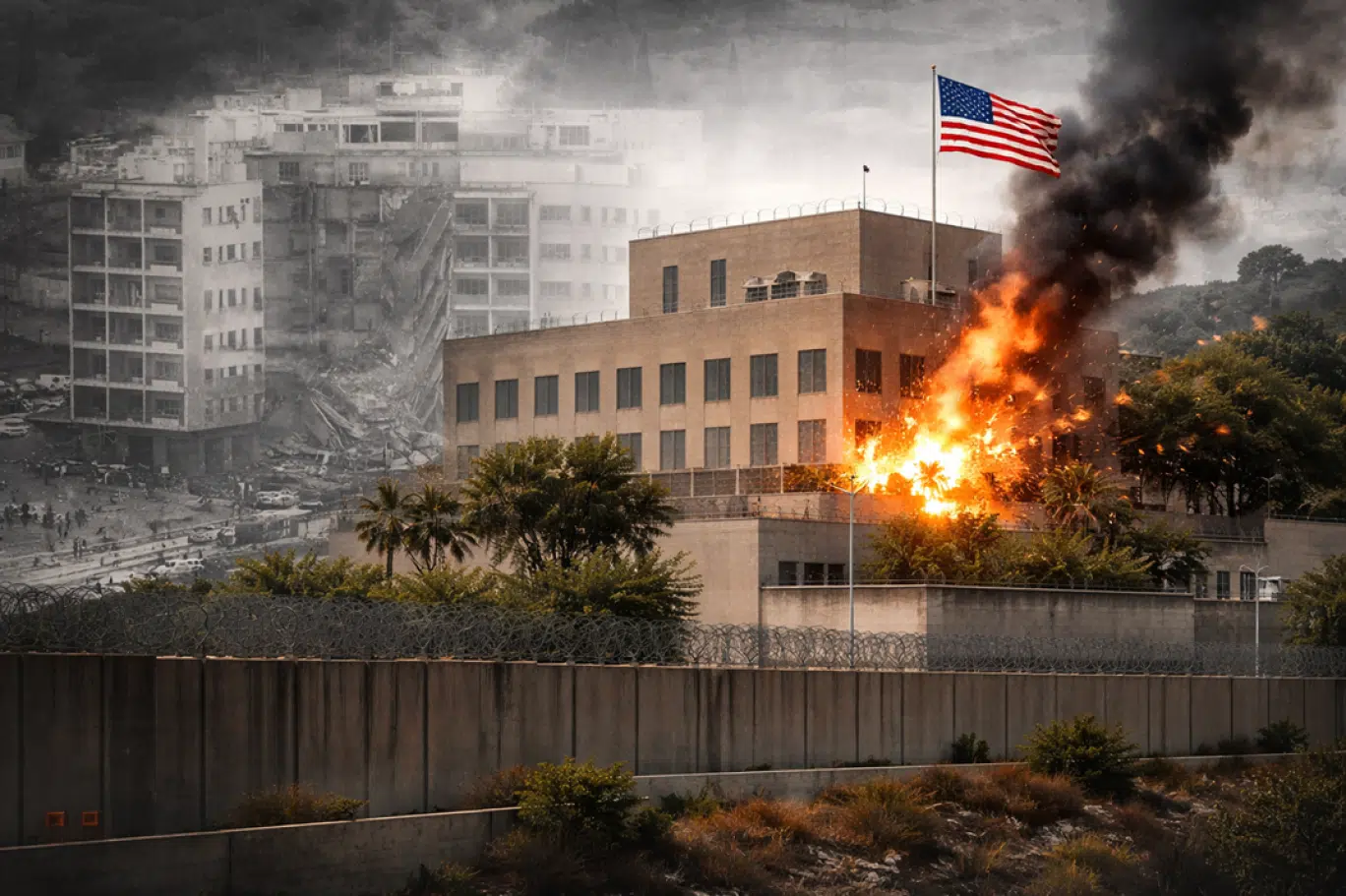
Media and security sources confirmed, according to what they read, that the missile was directed at an American target inside Lebanon, suggesting that it was the American embassy in Awkar or one of the air bases used within the American military support programs for the Lebanese army, especially Hamat or Rayak.
This hypothesis gains additional importance in light of the nature of the American deployment in Lebanon, which is not based on permanent combat bases, but rather on a network of military, technical and logistical cooperation with the Lebanese army that includes training, transfer of equipment, development of air infrastructure, and support for operational capabilities in combating terrorism and protecting borders within programs supervised by the US Central Command, known as “CENTCOM” within the framework of the military partnership strategy with allied armies in the Middle East.
While all hypotheses and leaks remain until now without decisive confirmation, preliminary cross-checked security data indicate that the trajectory of the missile object that was detected over Keserwan was heading from the east towards the Lebanese coast, which strengthens the hypothesis that it was launched from within Lebanese territory or from the nearby Syrian area, and not directly from Iran. Military estimates also suggest that the interception operation took place within the umbrella of the US naval air defense deployed in the eastern Mediterranean, via a naval vessel belonging to the US Sixth Fleet, a type of interception that was previously used in confronting similar threats originating from Iranian agents in the region.
Until now, there has been no official announcement about adopting the operation, whether by Iran or Hezbollah.
mailbox
This incident intersects with increasing security analyzes that say that as the options for direct confrontation between Tehran and Washington become more complex, using the Lebanese arena becomes less costly politically and militarily. This hypothesis is based on a well-known equation in the Iranian strategy that is based on responding to American interests outside American territory, and through arenas of indirect influence, using asymmetric deterrence tools that combine media warfare, security pressure, and the threat of striking high-value symbolic targets.
This approach falls within the doctrine of asymmetric deterrence that Iran has adopted for years, which is based on targeting American interests through networks of regional allies instead of entering into a direct confrontation with regular American forces. This is what appeared previously in Iraq, Syria, and the Red Sea, and it seems that it has begun to gradually withdraw in the Eastern Mediterranean as well.
In this context, the US Embassy in Awkar, and the military facilities that host US support programs for the Lebanese Army, become symbolic and practical targets at the same time, because they represent operational nodes within the network of US partnerships in the Middle East aimed at enhancing the capabilities of allied countries and containing Iranian influence.
The American statements also confirm that Washington is closely following field developments, but it avoids issuing a decisive official position at this stage, pending the completion of the intelligence and technical assessment of the missile’s trajectory and the nature of the party behind its launch.
Explosive diplomatic memory
It is not possible to read the current threats without returning to the experience of the Lebanese Civil War (1975-1990), when the capital, Beirut, turned into a bloody arena in the American-Iranian conflict, through the bombing of the American embassy in April 1983, then the headquarters of the American Marines and the French forces in October of the same year, and in 1984, the American embassy in Awkar was also targeted. These attacks killed and injured hundreds.
Today, with the escalation of tension between Washington and Tehran, the same question returns: “Are we facing a reproduction of the model of ‘explosives diplomacy’ in Lebanon, but with more advanced tools that include precision missiles, drones, cyber warfare, and media deterrence campaigns?”
The real concern among political and security circles is not only related to the possibility of targeting American facilities, but rather to the danger that Lebanon will once again turn into an arena for settling regional scores managed by a decision outside its borders, especially in light of the Lebanese military establishment’s reliance on continuous American support programs since 2006 whose value exceeded more than $2.5 billion in direct security assistance, in addition to more than $4 billion in American bilateral aid to Lebanon since 2010, which makes the military relationship between the army Lebanon and Washington are one of the most important axes of the strategic partnership in the Eastern Mediterranean.
Hamat base
Hamat Air Base is located in Batroun District. It was established in the 1960s under the name “Pierre Gemayel Airport,” before it was transformed during the civil war into a military site used by Syrian forces. After the withdrawal of the Syrian army in 2005, it was officially reorganized as a Lebanese Air Force base.
Since then, the base has been used for training, logistical and humanitarian missions, in addition to search and rescue and air support operations inside Lebanon. It has been used as an operating and receiving point for reconnaissance and air surveillance platforms and light attack helicopters within the US military support programs for the Lebanese Army, including ScanEagle systems, MD-530F helicopters and Super Tucano aircraft, which are systems that enhance the capabilities of tactical air surveillance, border control and combating irregular threats.
However, its inclusion in a video report broadcast by the Iranian “Al-Alam” channel before the outbreak of the current war, as part of a potential target bank in the event of a confrontation with the United States, has re-shed light on it as a sensitive point of contact within the military cooperation network between the Lebanese army and Washington.
The Lebanese Ministry of Defense officially confirmed that the Hamat base is a Lebanese facility completely under the command of the Lebanese Army, and that it does not constitute an American base, but it hosts foreign training teams within military cooperation programs, which is a common model in the “capacity building” strategy adopted by the United States instead of establishing permanent combat bases in partner countries. However, this type of cooperation is sufficient to include it in the Iranian targeting calculations.
Rayak base
Rayak Air Base in the Bekaa, eastern Lebanon, constitutes one of the most important platforms for receiving foreign military aid allocated to the Lebanese Army, along with Beirut Air Base within the campus of Rafik Hariri International Airport and Hamat Base.
This aid includes military equipment, weapons, and ammunition that arrive via flights as part of official cooperation agreements. The base also includes an operational training center that was established under the supervision of a team of American special units in 2013 to qualify special intervention units to fight in built-up areas, reconnaissance, air support, and tactical medical evacuation.
This cooperation comes within an ongoing training program supervised by the US Central Command, and aims to raise the readiness of Lebanese units in counter-terrorism missions, controlling the eastern borders, and confronting cross-border armed organizations, which makes the base part of the regional security partnership system linked to the international coalition against terrorism.
In this specific sense, Rayak is included in Iranian calculations as an indirect support point for the American-backed Lebanese military structure, even if it is not an American base in the traditional military sovereign sense.
The American Embassy in Awkar
The US Embassy in Awkar is one of the largest US diplomatic facilities in the Middle East. It is not just a traditional consular mission, but rather a multi-agency command platform that includes representatives from the Departments of Defense, Commerce, Justice, and USAID, and manages wide-ranging political, security, and economic assistance programs in Lebanon.
The embassy represents a major coordination center for US military support programs for the Lebanese Army, including training, equipping, and developing air and ground capabilities, in addition to direct coordination with the US Central Command in the files of counter-terrorism, border control, and enhancing aerial reconnaissance capabilities.
Work is underway to establish a huge new embassy complex on an area of approximately 43 acres and at an estimated cost of approximately one billion dollars, which reflects the exceptional strategic importance that Washington attaches to its diplomatic presence in Lebanon, and places the complex among the largest American diplomatic facilities in the world after the Baghdad complex, according to Western reports.
For this reason, the embassy is a symbolic and strategic target in any regional confrontation between the United States and Iran. This reality brings to the fore the experience of targeting the American embassy in Beirut in 1983, which constituted a turning point in the nature of the regional conflict within Lebanon.
The hypothesis that the US embassy was specifically targeted in the recent missile incident is strengthened in light of it being the command center of a multi-agency mission with an advanced security-political function within the US deployment network in the eastern Mediterranean.
Reports circulating in the context of the regional escalation also indicate the possibility of including Cyprus, a country close to Lebanon, within the Iranian target bank, given its role in hosting logistical and intelligence facilities linked to Western operations in the eastern Mediterranean, in addition to its use as a rear reference point for humanitarian and military operations in crises in the region.
If the scope of the confrontation expands to include this geography, the entire eastern Mediterranean will become a theater of operations in the current war.
1092623-1890074811.jpg
Hamat Air Base in northern Lebanon (official website of the Lebanese Army)
Military reading
Retired Brigadier General Khalil Helou believes that the Iranian missile that was intercepted over Lebanese airspace cannot be separated from the context of the direct confrontation between Iran and the United States in the eastern Mediterranean, and it is likely that it was directed towards an American target inside Lebanon, and at the forefront of these targets is the American embassy in Awkar or the Hamat air base.
Helou points out that the trajectory of the missile fragments falling from the coast to the highlands in Keserwan indicates that it was intercepted at a point close to its final target, which reinforces the hypothesis that it was heading towards a specific location within Lebanese territory and not crossing towards another theater of operations. He points out that the American and Israeli early warning systems are able, from the moment the missile is launched from Iran, to determine its final path.
Al-Helou confirms that the American embassy in Beirut represents a target of high strategic and symbolic value in Iranian calculations, because it constitutes the center for managing American political and security influence in Lebanon, while the Hamat base, despite being a Lebanese facility, remains part of the military cooperation system with Washington, which places it within the circle of indirect pressure on American interests in the region.
Helou concludes that the interception of the missile over Lebanon indicates that the country has practically moved into the scope of the Iranian-American missile engagement, a development that raises the level of dangers to Western interests present on Lebanese territory.
Regional deterrence messages
In turn, Brigadier General Fadi Dawoud considers that the incident of the Iranian missile that was intercepted over Lebanon must be understood within the framework of the strategic messages exchanged between Iran and the United States, and not as a direct targeting of Lebanon itself, indicating that determining the final target of the missile remains linked to its type, path, and the party that intercepted it.
Daoud confirms that the Hamat base is not an American base in the operational sense, but rather a facility belonging to the Lebanese Air Force that sometimes hosts training elements within military cooperation programs with Washington. The same applies to the Rayak base, which makes targeting them an unlikely option in Iranian calculations if the goal is to send a direct message to the United States.
As for the American embassy in Awkar, Daoud sees it as a different target in terms of political and symbolic value, but it remains a sensitive target that is difficult to target at a stage in which the military confrontation overlaps with open negotiating paths between Tehran and Washington, which makes the possibility of targeting it theoretically present but unlikely in practice at this time.
He adds that the interception of the missile is likely linked to the American defense system deployed in the eastern Mediterranean, which includes the protection of American targets and Western bases in Cyprus in addition to American diplomatic facilities in Lebanon, which reflects the inclusion of Lebanese airspace within the broader scope of regional deterrence between Washington and Tehran.
Published articles represent the opinion of their authors
#American #interests #Lebanon #entered #bank #Iranian #targets #Voice #Lebanon #Voice #Lebanon
Have American interests in Lebanon entered the bank of Iranian targets? – Voice of Lebanon – Voice of Lebanon
– الدستور نيوز
اراء و اقلام الدستور – Have American interests in Lebanon entered the bank of Iranian targets? – Voice of Lebanon – Voice of Lebanon
المصدر : www.vdl.me